
In industrial software, mixing interface, PLC communication, business rules and data access into one block makes the system hard to test, support and evolve.
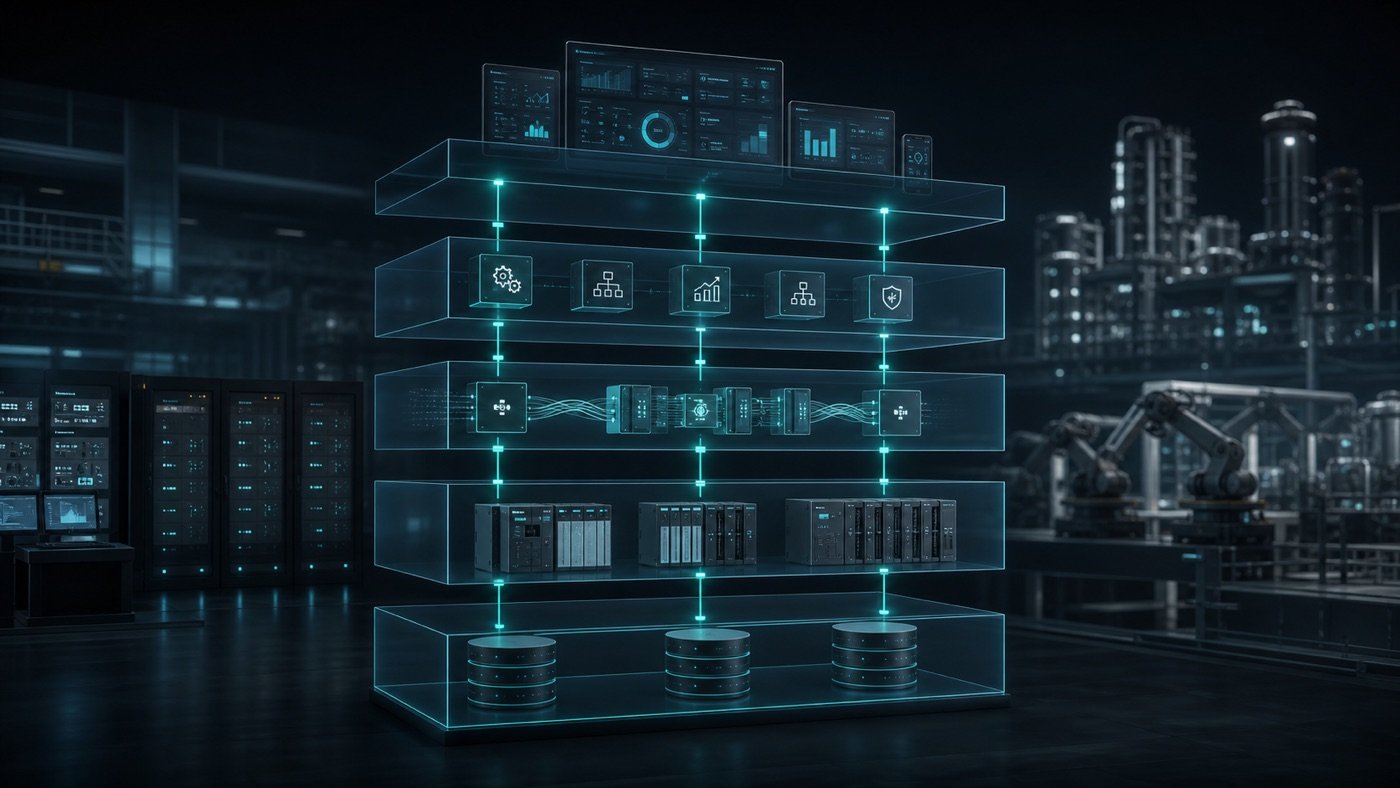
Main layers of an industrial application
A healthy architecture often separates operator interface, business rules, integration services, data access, configuration and logging. This separation makes it possible to change one piece without breaking the whole system.
- Clear operator interface.
- Centralized process rules.
- Libraries for PLCs, RPC, APIs or SQL.
- Persistence and traceability.
- Diagnostics and recovery.
Design integrations as critical components
PLC, database and legacy-system integrations should have clear contracts: what they read, what they write, how often, which errors exist and what happens if a response does not arrive.
This prevents frozen interfaces, unclear operator messages and support teams guessing.
Logging for real support
Useful logging records events, critical data, errors, communication timing and system decisions. It should not be noise; it should help reconstruct what happened during a failure.
In industrial modernization, separating RPC, PLC, logging and database libraries can enable reuse in other areas and accelerate diagnostics when failures occur.
View related case ↗Architecture designed for maintenance
An industrial application will live beyond its first version. It should be configurable, deployable, recoverable and understandable by more than one person.
- Document integrations and dependencies.
- Separate configuration from code.
- Use understandable errors and states.
- Design tests around plant scenarios.
- Define versioning and support strategy.
Recommended next step
If an application will be critical, draw the architecture before development: layers, data sources, failure points, tests and recovery criteria.
Want to review your industrial software architecture?
Axyz can help separate responsibilities, reduce risk and prepare a maintainable path.
Frequently asked questions
Which layer should talk to the PLC?
Ideally a dedicated layer or library, not the interface directly.
Why separate logging?
Diagnostics should be consistent across the application and easy to extend.
Is client-server always necessary?
Not always. It depends on users, equipment, data, security and deployment.